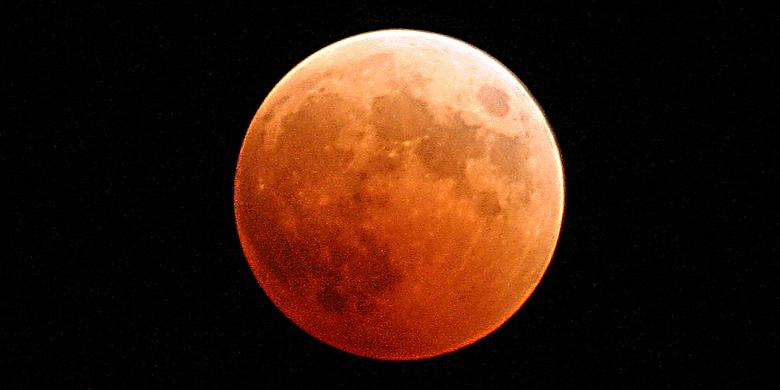
Lunar Eclipse - Do not miss out. Wednesday (10/08/2014), the phenomenon of a total lunar eclipse the "bonus" will greet his other phenomena. All Indonesia could see it.
Based on the release of the Meteorology, Climatology, and Geophysics (BMKG), the phenomenon of eclipse tomorrow will begin at 15:14 am and ended at 20:25 pm. Meanwhile, the period of totality will last for 1 hour, at 17:24 to 18:24 pm.
Each region in Indonesia has different luck in witness total lunar eclipse tomorrow.
Residents of eastern Indonesia are lucky because they can watch the full eclipse phase. The initial phase consists of the eclipse, partial lunar eclipse, totality, to return again to the end of the partial eclipse and eclipse.
The time eclipses the one that makes people lucky East Indonesia. When the eclipse began, it was already dusk, at 17:14 CEST.
Central Indonesian citizens not as fortunate friends in Eastern Indonesia. When the eclipse began, the time is still showing at 16:14 pm. However, the Central Indonesian citizen is still likely to witness a partial eclipse in the early stages.
Even so, Indonesia and the Middle East still had the same luck in watching the planet Uranus with the naked eye that accompany the eclipse phenomenon.
Sudibyo Ma'rufin amateur astronomers through conversations with Kompas.com, Tuesday (10/07/2014), say, Uranus will appear with a magnitude +5. The planet will be visible to the right of the Moon.
Uranus will only appear to the naked eye from Indonesia and the Middle East because of the limited time of totality of eclipse.
Uranus is a planet far away from Earth. Two factors that determine the appearance of the planet with the naked eye is the distance from the Earth and the darkness of the night sky.
Factor levels are met into the night sky only when the Moon enters the phase of eclipse tomorrow.
Meanwhile, the Earth's distance factor Uranus are met. Because, on Wednesday (10/08/2014) at 03.00 am in the morning, the planets are in the closest distance to Earth, just across the Sun from the point of view of an observer on Earth.
Do not miss out. Wednesday (10/08/2014), the phenomenon of a total lunar eclipse the "bonus" will greet his other phenomena. All Indonesia could see it.
Based on the release of the Meteorology, Climatology, and Geophysics (BMKG), the phenomenon of eclipse tomorrow will begin at 15:14 am and ended at 20:25 pm. Meanwhile, the period of totality will last for 1 hour, at 17:24 to 18:24 pm.
Each region in Indonesia has different luck in witness total lunar eclipse tomorrow.
Residents of eastern Indonesia are lucky because they can watch the full eclipse phase. The initial phase consists of the eclipse, partial lunar eclipse, totality, to return again to the end of the partial eclipse and eclipse.
The time eclipses the one that makes people lucky East Indonesia. When the eclipse began, it was already dusk, at 17:14 CEST.
Central Indonesian citizens not as fortunate friends in Eastern Indonesia. When the eclipse began, the time is still showing at 16:14 pm. However, the Central Indonesian citizen is still likely to witness a partial eclipse in the early stages.
Even so, Indonesia and the Middle East still had the same luck in watching the planet Uranus with the naked eye that accompany the eclipse phenomenon.
Sudibyo Ma'rufin amateur astronomers through conversations with Kompas.com, Tuesday (10/07/2014), say, Uranus will appear with a magnitude +5. The planet will be visible to the right of the Moon.
Uranus will only appear to the naked eye from Indonesia and the Middle East because of the limited time of totality of eclipse.
Uranus is a planet far away from Earth. Two factors that determine the appearance of the planet with the naked eye is the distance from the Earth and the darkness of the night sky.
Factor levels are met into the night sky only when the Moon enters the phase of eclipse tomorrow.
Meanwhile, the Earth's distance factor Uranus are met. Because, on Wednesday (10/08/2014) at 03.00 am in the morning, the planets are in the closest distance to Earth, just across the Sun from the point of view of an observer on Earth.
Related resources: Kompas, Metro Tv, iBerita and more.


No comments:
Post a Comment